The death of a loved one is never easy. Along with the emotional loss, families often find themselves dealing with various legal and financial matters. One of the most common questions that arises is how to access the deceased person’s bank accounts, investments, fixed deposits, shares, or other movable assets.
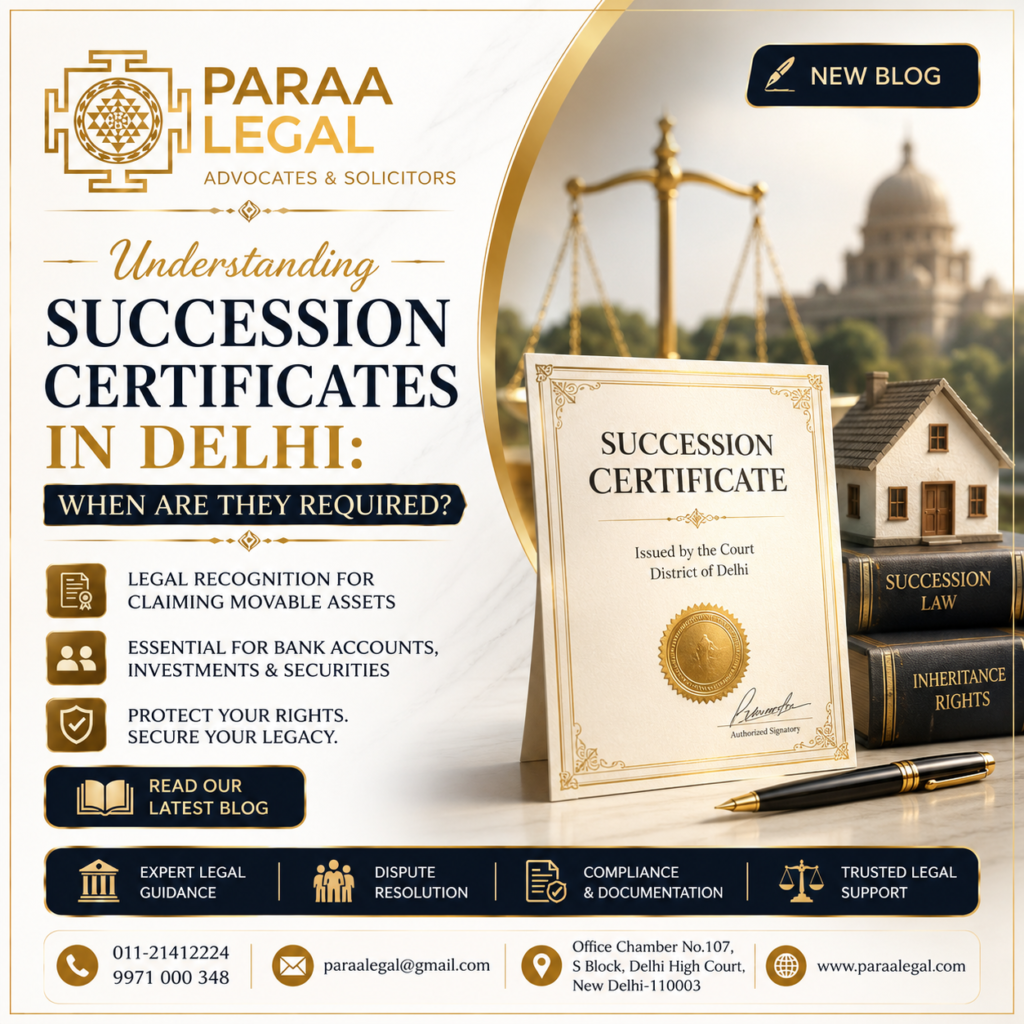
In many such situations, a Succession Certificate becomes an important legal document. While many people have heard of it, few fully understand its purpose, when it is required, and how it can help legal heirs manage the assets left behind by a deceased family member.
This article explains the concept of a succession certificate in simple terms and discusses when it may be required under Indian law.
What is a Succession Certificate?
A succession certificate is a legal document issued by a competent court that authorizes the legal heirs of a deceased person to collect and manage certain movable assets and debts belonging to the deceased.
In simple words, it serves as proof that the person holding the certificate is legally entitled to receive money, securities, or other movable assets left behind by the deceased.
Many financial institutions require a succession certificate before releasing funds to family members, especially when there is uncertainty regarding the legal heirs.
Why is a Succession Certificate Important?
After a person’s death, banks, financial institutions, companies, and government authorities often need legal proof before transferring assets or releasing money.
Without proper documentation, institutions may refuse to transfer funds, even if the relationship between the deceased and the claimant is clear.
A succession certificate provides legal protection to both the institution releasing the funds and the person receiving them. It helps avoid future disputes and ensures that assets are transferred through a legally recognized process.
When is a Succession Certificate Required?
A succession certificate is generally required when a person dies without leaving clear instructions regarding certain movable assets.
For example, families may need a succession certificate to claim:
- Bank account balances
- Fixed deposits
- Shares and securities
- Insurance proceeds in certain situations
- Provident fund claims
- Bonds and investments
- Outstanding debts payable to the deceased
The requirement often depends on the nature of the asset and the policies of the institution holding the asset.
Is a Succession Certificate Required If There Is a Will?
Many people assume that a succession certificate is always required after a person’s death. However, this is not necessarily true.
If the deceased has left behind a valid Will, the process may involve other legal procedures depending on the circumstances and the nature of the assets involved.
A succession certificate is generally associated with claims relating to movable assets and is commonly sought where additional legal proof of entitlement is required.
The exact legal requirement can vary from case to case.
Who Can Apply for a Succession Certificate?
Generally, close family members and legal heirs may apply for a succession certificate.
These may include:
- Spouse
- Children
- Parents
- Other legal heirs recognized under applicable succession laws
Where multiple legal heirs exist, the court examines the relationship of the applicants and any objections raised before granting the certificate.
What is the Process for Obtaining a Succession Certificate in Delhi?
The process usually begins with filing an application before the appropriate court having jurisdiction.
The application contains details such as:
- Information about the deceased person
- Date of death
- Details of legal heirs
- Information regarding the assets involved
After examining the application, the court may issue public notice inviting objections from any interested person.
If no valid objections are received and the court is satisfied with the evidence, a succession certificate may be granted in favor of the applicant.
The time required may vary depending on the facts of the case and court procedures.
Common Challenges Faced by Families
Succession matters often become complicated due to family disagreements, incomplete documentation, or uncertainty regarding legal heirs.
Some common challenges include:
Disputes among family members regarding entitlement, missing financial records, multiple claimants, or lack of awareness regarding the legal process.
Seeking timely legal guidance can often help families avoid unnecessary delays and complications.
How Can Proper Estate Planning Help?
Many succession-related disputes can be reduced through proper planning.
Maintaining updated records, preparing a legally valid Will, and ensuring that nominations are properly updated can make the process easier for family members in the future.
While legal documentation may not eliminate every issue, it often provides clarity and reduces uncertainty.
A succession certificate plays an important role in helping legal heirs access and manage the movable assets of a deceased family member. It provides legal recognition of a person’s right to collect debts and securities and helps facilitate the transfer of financial assets through a structured legal process.
Understanding when a succession certificate is required can help families navigate an already difficult period with greater clarity and confidence.
At Paraa Legal, we regularly assist individuals and families in understanding succession-related legal procedures, inheritance matters, and property-related legal issues.
Contact Paraa Legal
Paraa Legal, Advocates & Solicitors
Adress : Chamber No. 107, S Block
Delhi High Court, New Delhi – 110003
Mob: 011-21412224 / 9971 000 348
Email: paraalegal@gmail.com
Web: www.paraalegal.com
Disclaimer: This article is intended solely for informational purposes and should not be construed as legal advice.